LaGuardia firefighter heard ‘stop, stop, stop’ before deadly crash but didn’t know who it was for
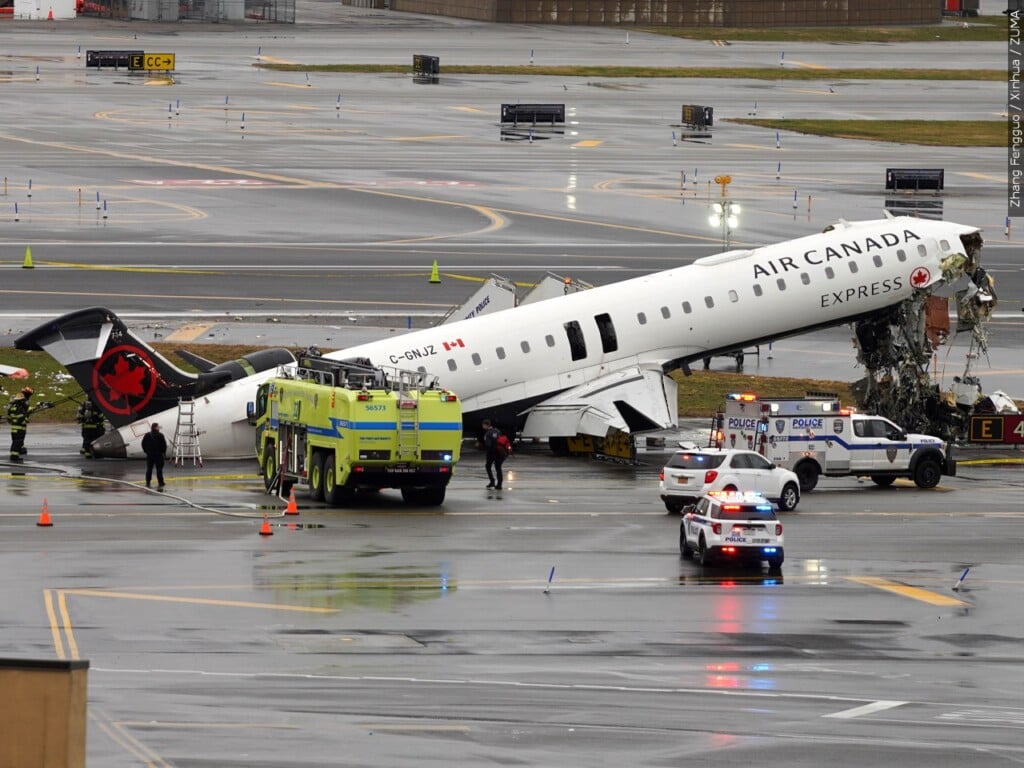
NEW YORK (ASSOCIATED PRESS) – Sources from AP say that a firefighter whose truck collided with an Air Canada jet last month on a runway at New York’s LaGuardia Airport, killing both pilots, heard an air traffic controller warn “stop, stop, stop” but didn’t know who it was for, federal investigators said Thursday.
The National Transportation Safety Board said in a preliminary report on the March 22 collision that a crash prevention system for air traffic controllers didn’t generate an audio or visual alert, and lights on the runway that act as a stop light for crossing traffic were on until about three seconds before the collision.
After the air traffic controller’s initial stop warning, the fire truck’s turret operator heard the controller say, “Truck 1, stop, stop, stop,” and realized the warning was for the truck to halt, the report said. By that time, the truck was already on the runway as Air Canada Express Flight 8646 was landing and speeding toward it.
The turret operator, one of two crew members in the fire truck, recalled that as the vehicle turned left, he saw the airplane’s lights on the runway, the report said, summarizing an interview investigators conducted with the crew member.
Air Canada Express Flight 8646 slammed into a fire truck while landing at New York’s LaGuardia Airport, killing pilots Antoine Forest and Mackenzie Gunther. An air traffic controller had cleared the truck to cross the runway just 12 seconds before the plane touched down, federal investigators said.
The flight, a CRJ900 regional jet from Montreal, had more than 70 people on board. About 40 people, including the two people in the fire truck, were taken to hospitals. A flight attendant still strapped in her seat survived after being thrown onto the tarmac.
The fire truck was leading a convoy of six vehicles, including four fire trucks, a stair truck, and a police vehicle, responding to an emergency involving a strong odor reported in the cabin of an outbound United Airlines jet.
The tower at LaGuardia was busier than usual the night of the crash because flight delays pushed the number of arrivals and departures after 10 p.m. to more than double what was scheduled, according to data from aviation analytics firm Cirium.
Planes were landing every few minutes, with a dozen flights arriving between 11 p.m. and when the crash happened less than 40 minutes later. At the same time, the tower was coordinating the emergency response to the unusual odor that was making flight attendants feel ill.
LaGuardia is one of 35 major U.S. airports with an advanced surface surveillance system to help eliminate dangerous runway incursions and prevent crashes. Controllers in these airports have a display in the tower that’s supposed to show the location of every plane and vehicle.
The system, known as ASDE-X, didn’t work as intended at the time because the fire truck wasn’t outfitted with a transponder, investigators said. There were also emergency vehicles behind the truck, and the proximity of the vehicles merging kept the system from triggering an alarm, investigators said.
According to air traffic control transmissions, Flight 8646 was cleared to land on Runway 4 at 11:35 p.m.
About two minutes later — and 25 seconds before the crash — the fire crew asked to cross the same runway, which was between the airport’s fire station and where the United Airlines jet had parked.
Five seconds later, with Flight 8646 approaching the runway a little more than 100 feet (30 meters) above the ground, an air traffic controller cleared the fire truck to cross the runway.
Then, just nine seconds before the crash, the controller frantically told the fire crew: “Stop. Stop Stop. Stop. Truck 1. Stop. Stop. Stop. Stop.” A second later, the plane’s landing gear touched down.
It was the first deadly crash at LaGuardia in 34 years.