New invasive tick poses major risk to livestock
RAYMOND, Miss. – According to a press release, scientists at Mississippi State University are on the lookout for a new invasive species of tick, and they want Mississippians to know their help is crucial in detecting the pest.
The Asian long-horned tick, Haemaphysalis longicornis, has been confirmed in neighboring Arkansas, Alabama and Tennessee, and more than 20 other states. They were first discovered in New Jersey in 2017, where they infested a herd of sheep.
“As of August 21, there have been zero confirmed reports of the Asian long-horned tick in Mississippi,” said Santos Portugal, an entomologist with the MSU Extension Service. “That doesn’t necessarily mean that they aren’t here, only that their presence has not yet been confirmed. It has been collected in neighboring states but not yet near the Mississippi border.”
The Asian long-horned tick is a major pest of livestock, but they feed on all types of animals, including birds, wildlife and pets, and even people. The female’s ability to reproduce rapidly on its own without mating — up to 2,000 eggs at a time — means one animal, person or area can be infested with hundreds or thousands of ticks quickly.
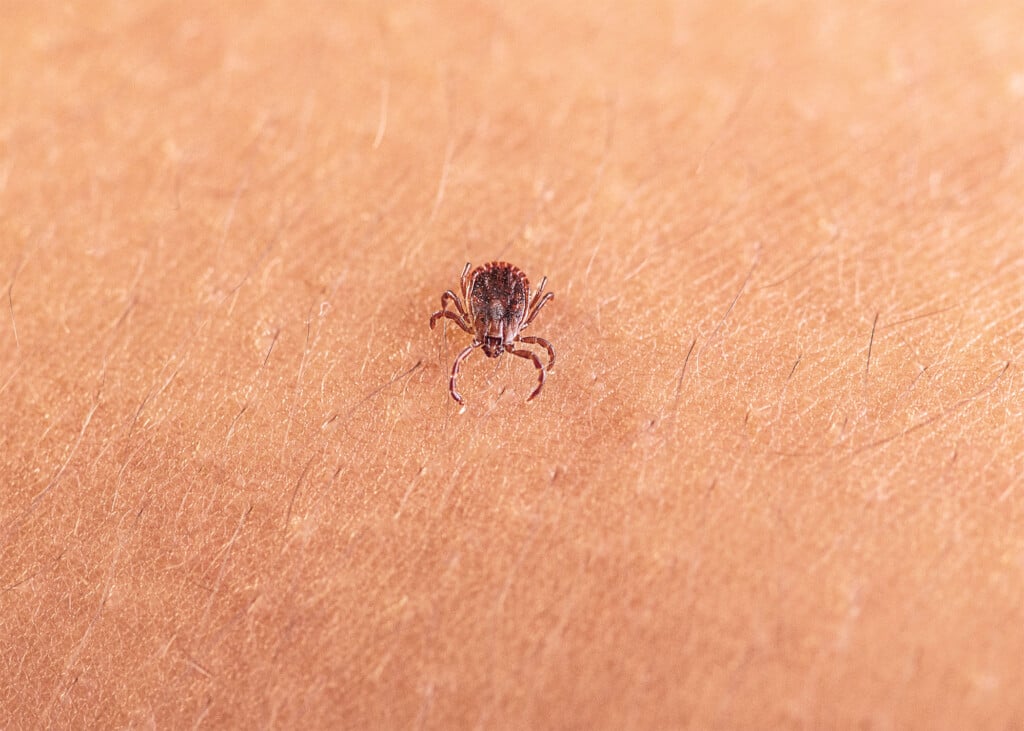
These ticks are small and reddish-brown with no white coloration or spots. They have short, wide mouthparts and will appear in unusually large numbers clustered on livestock or another animal.
Immature ticks, or nymphs, are about 2 millimeters in size. Unfed adults measure 3 to 4 millimeters, which is about the size of an apple seed. Engorged females are 4 to 10 millimeters in size, while other stages of the pest are much smaller, around the size of a sesame seed or smaller.
They prefer areas with tall grass and high humidity, such as pastures, but have also been found in shaded lawns in neighborhoods.
Their ability to reproduce in such high numbers in a short amount of time, adapt and spread to new climates and spread disease makes them especially concerning to animal health officials, said Carla Huston, Extension veterinarian and professor with the MSU College of Veterinary Medicine.
“These ticks can begin reproducing at six months versus the two years typical of more common tick species. In other words, a single tick can create a whole new population of ticks in an area in a short amount of time,” Huston said.
“Hundreds to thousands of these small ticks can be found on an animal at one time. The ticks themselves can cause great stress, a reduction in growth or production and even death due to the extreme blood loss from the tick infestation. This is especially a concern for sheep and goats,” she said.
They are known to transmit livestock and human diseases, including anaplasmosis, babesiosis, ehrlichiosis, theileriosis and rickettsiosis, in addition to several viruses.
One particular type of theileriosis transmitted by this pest has caused a lot of concern in the cattle industry, Huston said. Bovine theileriosis, or T. orientalis Ikeda, can cause serious illness in animals and has no vaccine or treatment.
“We have not diagnosed Ikeda in Mississippi,” she said.
The best defense for livestock owners against these ticks is to maintain a livestock tick control program and keep vegetation cut down.
“Livestock owners should consult their veterinarian regarding which tick prevention products to use on their animals. Pets also need to be protected against ticks and other external parasites,” Huston said.
“Elimination of tick habitat is not entirely possible in farm and pasture settings, but keeping tall grass and overgrown brush cut down may help reduce infestation,” she said. “Keeping cattle out of wooded areas may also reduce the number of ticks that can attach to your cattle.”
In Asia, these ticks are associated with tick-borne human diseases and the agents that cause them, including Lyme disease, Ehrlichia, rickettsia, anaplasma and Powassan virus.
“Thankfully, as of right now, these ticks are not believed to be a significant vector for human diseases in the United States, although researchers are continuing to monitor that potential,” Portugal said.
While Asian longhorned ticks have yet to be confirmed in the state, some of Mississippi’s native ticks still pose a risk for disease transmission, and people should try to prevent tick bites, no matter what the species, Portugal said.
When in areas where ticks are likely to be, including heavily wooded areas or places with thick vegetation, using insect repellants proven effective by the U.S. Environmental Protection Agency, or EPA, can reduce your chances of being bitten. People should also wear light colored clothing to more easily see ticks, tuck pant legs into socks or boots, and check the entire body for ticks immediately after being outside.
Several active ingredients for skin-applied repellants effective against ticks are registered with the EPA and can be found on the EPA website at https://www.epa.gov/insect-repellents/skin-applied-repellent-ingredients.
Livestock owners and the public should remain vigilant and report the appearance of any unusual ticks or an abnormally large number of ticks, Huston said.
Portugal said Mississippians who encounter what they suspect may be Asian longhorned ticks should submit a sample for confirmation to the Mississippi State Department of Health’s Entomology and Vector Control Program.
Place ticks in a hard, leakproof container with isopropyl alcohol then place that container in a zip-close bag. Also send collection details, including date, time, location, the animal the tick was found on and the submitter’s contact information. More details on the submission process can be found on the MSDH website at https://msdh.ms.gov/page/14,0,119.html.
Mail specimen to Mississippi Public Health Laboratory, Attn: Dr. Wendy Varnado, 570 East Woodrow Wilson Ave., Jackson, MS 39215.
For more information on the Asian longhorned tick, read MSU Extension Publication 3367, “The Asian Longhorned Tick: A New Invasive Tick Species in the Eastern U.S.” at https://extension.msstate.edu/publications/the-asian-longhorned-tick-new-invasive-tick-species-the-eastern-us.
To see where the tick has been confirmed so far, visit the U.S. Department of Agriculture’s Animal and Plant Health Inspection Service website at https://www.aphis.usda.gov/livestock-poultry-disease/cattle/ticks/asian-longhorned.
For more information about Bovine theileriosis, visit the Mississippi Board of Animal Health website at https://www.mbah.ms.gov/disease-programs/bovine-theileriosis.