MSU Space Cowboys win International Rocket Engineering Competition championship
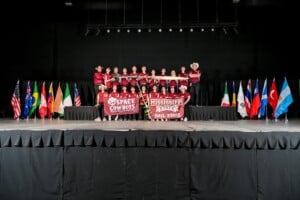
STARKVILLE, Miss.— According to an MSU press release, Mississippi State’s Space Cowboys Rocketry Team is celebrating its victory as champions of the recent 2026 International Rocket Engineering Competition last month.
Competing in Midland, Texas, against more than 140 collegiate teams from 16 countries, the MSU team secured the competition’s highest honor in late June during the organization’s 20th season.
The team’s competition rocket, Bandit, reached an altitude of 29,518 feet, just 482 feet shy of the 30,000-foot target for the 30K Commercial Off-the-Shelf division, winning this category as well for the second consecutive year. Unlike traditional altitude competitions, teams in this category are judged on their ability to design, build, and launch a rocket that reaches as close as possible to the prescribed altitude while meeting rigorous engineering, documentation, and safety requirements.
“Winning the overall championship was incredible, but what makes it even more meaningful is doing it during the Space Cowboys’ 20th anniversary,” said Shreyas Narsipur, the team’s faculty advisor. “Bandit was named to honor Outlaw, our first rocket, and I think this team showed just how far generations of Space Cowboys have brought this program.”
The championship represents one of the most significant milestones in the program’s history. Founded in 2006, the Space Cowboys competed in their first launch with Outlaw, establishing a tradition of student-led innovation. This year’s rocket was named in honor of that first flight vehicle, paying tribute to the program’s legacy while carrying it to new heights.
These victories build upon a long tradition of success at the IREC. In 2015, the Space Cowboys earned first place among 70 universities from seven countries with Asimov, which reached 22,562 feet. The team’s 2025 competition rocket Helios reached 28,639 feet.
Preparing for competition requires nearly a year of planning, design, manufacturing, testing and systems integration. Students gain hands-on experience in propulsion, avionics, structures, recovery systems, manufacturing, project management and systems engineering while applying concepts learned in the classroom to a real-world engineering challenge.
In addition to meeting the competition’s rigorous flight requirements, Bandit carried a 3U CubeSat-form-factor payload featuring multiple student-designed experiments, including a live telemetry downlink system. The payload provided another opportunity for students to integrate research, systems engineering and flight operations into a single mission.
“One win could be looked at as a fluke, but back-to-back wins put them in a very special position. This wasn’t a fluke. This is something we’re doing repeatably, and it shows these students have built a true engineering team,” Narsipur said.
The Space Cowboys are supported by MSU’s Bagley College of Engineering, Advanced Composite Institutes, Center for Advanced Vehicular Systems, the IDEELab and MSU Foundation donors, as well as industry partners Blue Origin, Aurora Flight Sciences, Northrop Grumann, Chem Trend, Heatcon Composite Systems, Mississippi Space Grant Consortium and Overland Tool Company whose continued support helps provide students with opportunities to tackle complex engineering challenges through experiential learning.
This year the MSU team included more than 70 students representing 11 different majors and fields.
In addition to the competition itself, team members participated in technical presentations, safety reviews and design evaluations. The Bagley College of Engineering is online at www.bagley.msstate.edu and can be found on Facebook, Twitter, Instagram and YouTube at @msuengineering.
Mississippi State University is taking care of what matters. Learn more at www.msstate.edu.