MSU-led horticulture mechanization study to streamline inventory for growers
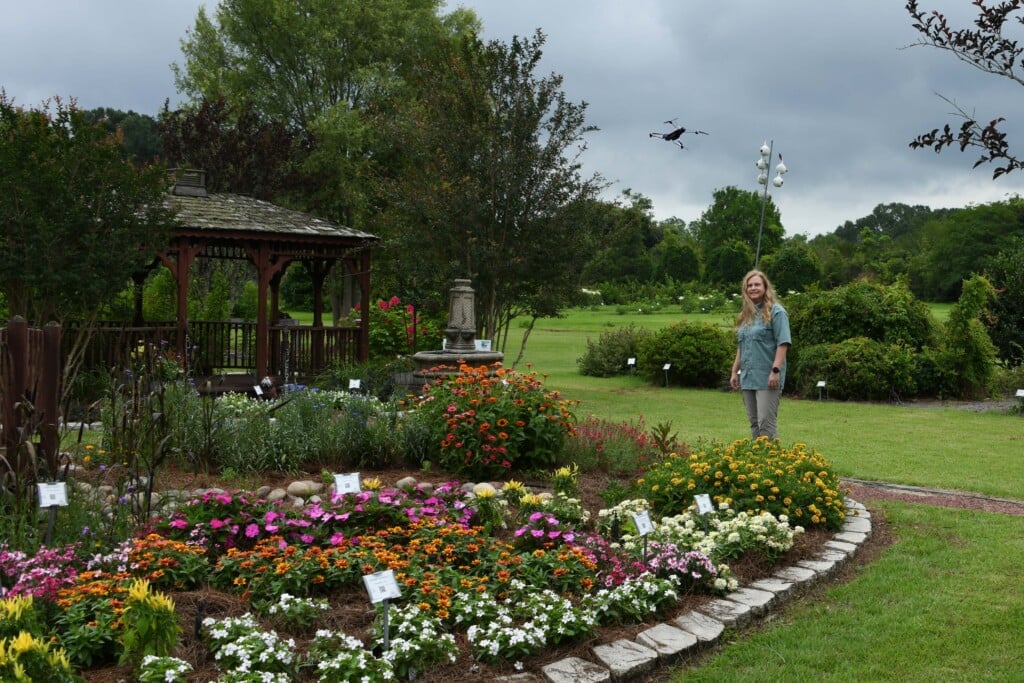
STARKVILLE, Miss.— Sources from an MSU Press Release say that growing high-demand ornamentals and specialty crops is a time and labor-intensive profession requiring constant monitoring of inventory and health, while also handling routine maintenance. A Mississippi State scientist is looking to the sky for solutions to these ground-level tasks.
Patricia Knight, director of coastal horticulture research at MSU’s Coastal Research and Extension Center and scientist in the Mississippi Agricultural and Forestry Experiment Station, is exploring how drone technology and artificial intelligence, or AI, might help growers save time and money on labor-intensive tasks. She has partnered to test cost-effective, industry-ready solutions with Siva Kumpatla, research leader for the USDA Agricultural Research Service’s Thad Cochran Southern Horticultural Laboratory, and Prabha Sundaravadivel, associate professor of electrical engineering at the University of Texas-Tyler.
The three-part study’s first phase is training a computer vision model to conduct plant inventories.
“It’s important to have an accurate inventory, but during the active shipping season, that gets pushed to the side,” said Knight, also a research professor in MSU’s Department of Plant and Soil Sciences. “Sending out a drone to count while your staff is busy with more immediate tasks could help you avoid selling plants you don’t have.”
The team has visited three South Mississippi nurseries, and the UT group has shot footage of different shrubs and trees, including magnolias, azaleas, roses, and more. The images are being used to train an AI model to identify every possible variation of the plants, beginning with magnolias.
“In this method, called manual labeling, we label the images for features such as ‘plant’ and ‘soil.’ After being fed enough images, the system learns to quickly distinguish between plant and soil and then between individual plants and counts them,” Kumpatla said. “We have repeated this process over and over, always with a manual check until we got to a high level of accuracy.”
To date, the model has achieved over 96% accuracy in identifying magnolias, and the team is working on transferring and tweaking the models to achieve similar accuracy in other species.
“It is challenging to distinguish young peach and plum trees through drone imaging as they have similar canopy structures and leaf shapes, and factors like humidity, strong sunlight and shadows can affect the clarity and resolution of the images,” Kumpatla said. “Improving the model’s accuracy in such scenarios is an ongoing process.”
Once this phase is complete, the team will investigate robotics to automate repetitive, labor-intensive tasks like moving plants, weeding and pruning. They also are exploring drones for targeted disease and pest control and identifying soil moisture and irrigation issues before the plants show signs of distress—all measures to help growers mitigate losses and save money.
“These technologies are available, but they are mostly implemented on large farms producing a single crop,” Knight said. “Most nurseries in Mississippi are smaller operations. We’re thinking about these producers that may grow hundreds of species and how we can deliver affordable technology to meet their needs.”
“I also think the project shows how effectively Mississippi State leverages our resources to work with outside partners like the USDA and University of Texas-Tyler,” she added. “Together, we’re working quickly and effectively to come up with real-world solutions that add value to the industry.”
Learn more about the university’s Mississippi Agricultural and Forestry Experiment Station at www.mafes.msstate.edu.
Mississippi State University is taking care of what matters. Learn more at www.msstate.edu.