Strait of Hormuz ship traffic slows to a crawl. Here’s what to know about the key oil waterway.
(CBS NEWS) – According to CBS News, the U.S. and Israel attacks on Iran are focusing attention on the Strait of Hormuz, a narrow but strategically vital waterway in the region that serves as a key artery for global oil shipments.
Marine traffic through the strait has slowed to a trickle since the outbreak of hostilities last week, heightening concerns that the conflict could constrain oil supplies and sharply drive up energy costs, Wall Street analysts said on Monday. The U.K. Maritime Trade Operations Center reported attacks on several vessels in the area on either side of the strait and warned of elevated electronic interference to ship navigation systems.
“Infrastructure is at risk throughout the region, and it’s not just at risk because of deliberate attacks, but also inadvertent attacks,” said Kevin Book, managing director at Clearview Energy Partners. “Shrapnel and debris from missile interceptions can fall onto facilities and disable them too, and so there are a number of challenges that come from this kind of conflict in an area with so much energy production.”
Here’s what to know about the Strait of Hormuz.
What is the Strait of Hormuz?
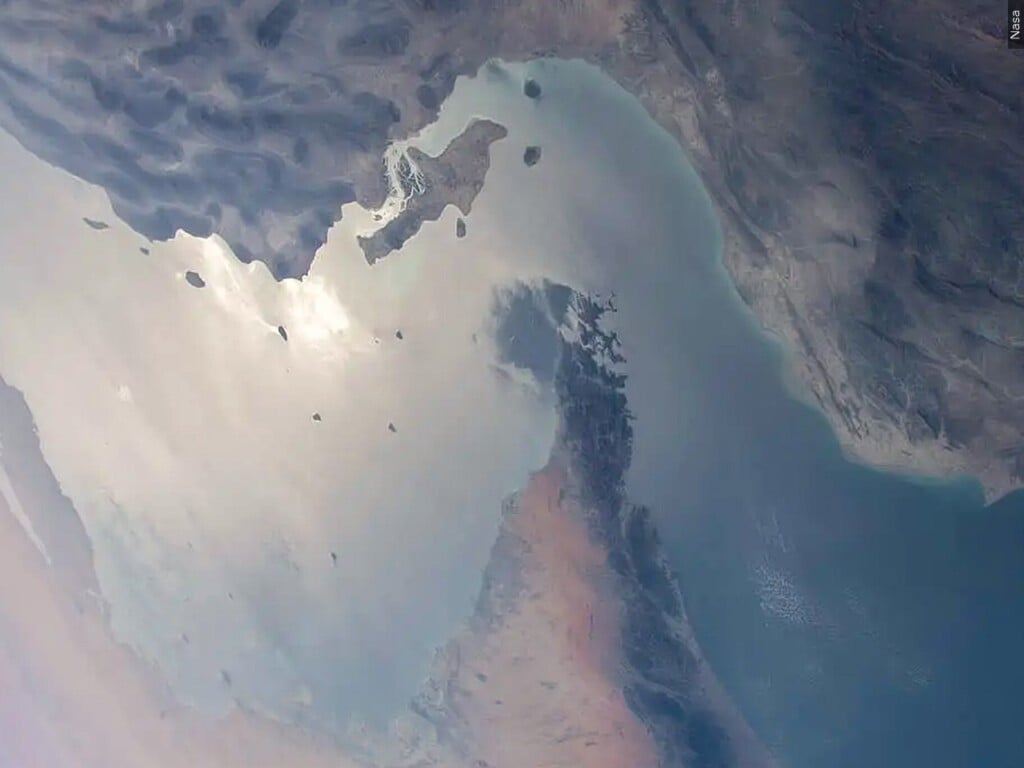
The strategic sea passage, located on Iran’s southern border, connects the Persian Gulf to the Gulf of Oman and the Arabian Sea. Long an important commercial trade route, the Strait of Hormuz ordinarily enables the flow of about 20% of global oil and liquefied natural gas shipments. Experts describe it as a strategic “choke-point” for crude.
The strait — almost 100 miles long and 21 miles wide at its narrowest point — allows the world’s largest vessels to transport oil and gas from the Middle East to China, Europe and the U.S. Most of that crude comes from Saudi Arabia, United Arab Emirates, Iraq, Kuwait, Qatar and Iran.
What is happening in the Strait of Hormuz?
The Iran war has brought the passage of oil tankers through the strait to a virtual standstill, with shipping giants Maersk and Hapag-Lloyd saying they were suspending all shipments through the strait.
As a result, oil prices spiked on Monday on concerns that a prolonged disruption of crude supplies in the region could sharply boost energy costs, including U.S. gas prices.
“It is de facto closed in that no one dares to go through,” Arne Lohmann Rasmussen, chief analyst at Global Risk Management, a provider of energy market insights, told CBS News. “You can be attacked, and you can’t get insurance or it is extremely expensive, so you have to wait until the security situation is better.”
“If oil and gas coming from the strait is cut off, that has significant ramifications for the market,” he added. “While there is no physical blockade, threats from the Iranians, plus drone and missile attacks, mean tankers are not going through the strait.”
A critical question moving forward is the duration of the war and how long the strait remains too dangerous to traverse, analysts said.
“If the reduction in tanker traffic continues for a week or so, it will be historic. Beyond that, it would be epochal for the oil market with prices rising to ration scarce supply and impacts in financial markets,” S&P Global head of crude oil research Jim Burkhard said in a report.
How high could oil prices rise if the strait remains closed?
Iran could struggle to indefinitely throttle ship traffic through the Strait of Hormuz as the U.S. and Israel degrade the country’s navy and other military capabilities, according to analysts. Blocking Iranian oil from being exported to markets overseas would also badly damage the company’s fragile economy, experts note.
“Iran has essentially two ways to close the strait. One is to harass or attack ships, and the other is to lay down mines,” Book of Clearview Energy told the Associated Press. “And without a navy, both of those things would be difficult.”
But an extended closure of the strait would likely cause oil prices to skyrocket, Rasmussen of Global Risk Management said.
“So far, it has just been a few days, but if this extends for weeks or months, the ramifications could be pretty severe, and we could see oil prices in the triple digits,” he told CBS News. “Then, there will be a significant drag on the world economy, and it could potentially trigger a recession. So in that sense, it’s a powerful weapon.”
Oil approaching or exceeding $100 a barrel is not a certainty. Benny Wong, senior energy analyst at Pitchbook, a provider of financial data and analysis, noted that the U.S. currently has a glut of oil that will insulate consumers from rising prices if tanker traffic through the strait is shut down for only a few days.
The U.S. is today the world’s largest oil producer and has boosted its reserves, while global oil demand has been soft in recent years amid tepid world economic growth, he said.
Are there alternatives to the Strait of Hormuz?
Oil that ordinarily would pass through the Strait of Hormuz by ship could be exported via other routes.
Those include the East-West Pipeline, also known as Petroline, a nearly 750-mile-long pipeline in Saudi Arabia that delivers oil to ports on the Red Sea. Shipments could also be diverted to the Abu Dhabi Crude Oil Pipeline, a roughly 400-mile pipeline in the United Arab Emirates that transports oil to a facility on the Gulf of Oman.
Yet such alternative routes can only accommodate a fraction of the volume of oil that ordinarily passes through the Strait of Hormuz on a daily basis, according to experts.
“There are no meaningful alternatives to that flow,” Wong said.