Watch live: Historic all-female spacewalk Friday
Watch a live stream of the spacewalk beginning at about 7:50 a.m. ET Friday in the video player above.
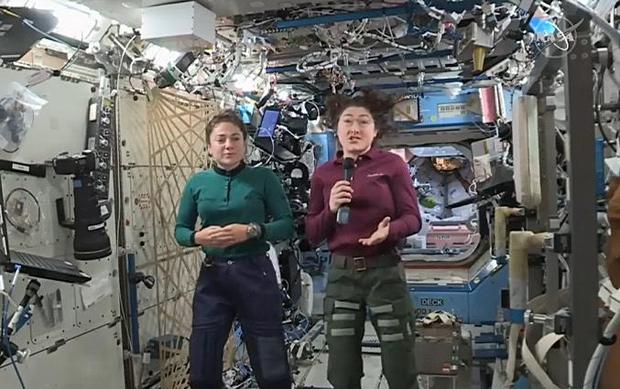
Astronauts Christina Koch and Jessica Meir, soaring 260 miles above a wave of public interest, gear up for history’s first all-female spacewalk Friday morning. The first two-woman EVA, or extravehicular activity, comes 54 years after a Russian cosmonaut carried out the first stroll in space just to prove it could be done — and to beat NASA to the punch.
Friday’s excursion, despite the unusual level of scrutiny, is a strictly-business affair to replace a faulty 232-pound battery charger in the lab’s solar power system. Any two of the space station’s four NASA sponsored astronauts could have done the work — they all received similar training — but Koch and Meir got the nod.
“It’s a sign of the slowly growing number of women in the astronaut corps,” Kathy Sullivan, who became the first American female to walk in space in 1984, said in an email exchange with CBS News. “The occasional woman as a bit of a novelty on a crew or a spacewalk or on a mission control console is giving way to the normalcy of more gender-diverse teams in all these arenas and women regularly taking on high-stakes tasks and leadership roles.”
Trending News
Floating in the Quest airlock compartment, Koch, making her fourth spacewalk, and Meir, making her first, were expected to switch their spacesuits to battery power around 7:50 a.m. EDT to kick off a planned five-and-a-half-hour outing. It’s the 221st spacewalk since International Space Station assembly began in 1998.
For identification, Koch, call sign EV-1, will be wearing a suit with red stripes and using helmet camera No. 18. Meir, EV-2, will be using an unmarked suit and using “helmetcam” No. 11.
Soviet cosmonaut Alexey Leonov carried out history’s first spacewalk in 1965. Cosmonaut Svetlana Savitskaya became the first woman to walk in space during an outing with a male cosmonaut in 1984, followed later that year by Sullivan, who joined astronaut David Leestma for a shuttle spacewalk.
While NASA managers and even the astronauts tend to view the all-female spacewalk as “just another milestone,” it has taken on heightened significance in the wake of a spacesuit sizing problem earlier this year that forced the station crew to call off plans for Koch and astronaut Anne McClain to make the first all-female EVA.
The station now is equipped with components for four suits, accommodating all three of NASA’s crew members as well as European Space Agency astronaut Luca Parmitano.
The mission of this spacewalk
Koch and Meir already were paired up for one of five spacewalks to replace aging solar array batteries. But after two of those excursions, a battery charge-discharge unit, or BCDU, failed knocking a newly-installed battery off line.
While the remaining battery installation spacewalks were put on hold, NASA managers opted to keep the Koch-Meir pairing intact, assigning them instead to the BCDU change out.
“The fact that it comes about largely via routine operational assignments rather than conscious PR moves is a good sign,” Sullivan said. “I’m sure the two astronauts are focused solely on the important task that’s been set for them, rather than the PR interest in their pairing, but hope they allow themselves to be amused by the novelty of it.”
The station’s electricity is provided by four huge solar wings, two on each end of a truss that stretches the length of a football field. Two dozen battery charge controllers, six per solar wing, divert electricity to powerful batteries for recharging when the lab is in sunlight and then deliver that stored power when the station moves through Earth’s shadow.
The flight plan called for Koch and Meir to remove one of three spare BCDUs from its perch on an external storage platform, carefully move it to the left end of the truss more than 50 yards from the station’s airlock, remove the faulty unit from a solar array equipment bay and install the replacement.
That was expected to restore power to the lab’s electrical system that was lost when the original charger failed after 19 years of normal operation, knocking a newly-installed lithium-ion battery off line.
With the BCDU swap-out complete, Koch and Meir will carry the faulty unit back to the airlock for eventual return to Earth aboard a future SpaceX Dragon cargo ship for troubleshooting and, if possible, repair.
If time is available, they also planned to carry out a few “get-ahead” tasks, adjusting multi-layer insulation around spare components to make access easier, routing an ethernet cable and installing a fitting on the European Space Agency’s Columbus laboratory module that will be needed when an experiment platform is attached later.
Because batteries lose their ability to recharge over time, NASA is in the process of replacing all 48 of the space station’s older-generation nickel-hydrogen batteries with 24 more powerful lithium-ion power packs, along with circuit-completing “adapter plates” to fill in for batteries that were removed but not replaced. In the upgraded system, each lithium-ion battery is charged and discharged by a single BCDU.
In 2017, spacewalkers replaced the 12 right-side inboard solar array batteries with six lithium-ion units. Last March, the 12 left-side inboard batteries were replaced. NASA currently is working to replace the left-side outboard batteries. The final set of lithium-ion batteries will be installed in the right-side outboard arrays next year
Three of six lithium-ion batteries were installed on the left outboard array during spacewalks Oct. 6 and 11 by Koch and Morgan. Shortly thereafter, engineers discovered one of the three BCDUs in that circuit had failed, sidelining one of the new batteries.
The failure is troubling because an identical charger failed last March after a new battery was installed for the left inboard array. NASA engineers want to make sure a generic problem of some sort is not present before proceeding with additional battery installations.



Leave a Reply